OLD WAR MOVIES

OLD WAR MOVIES

OLD WAR MOVIES

...The 20th century has been characterized by three developments of great political importance: The growth of democracy, the growth of corporate power and the growth of corporate propaganda against democracy.

Wednesday, July 29, 2015

Has missing Malaysia Airlines flight MH370 been discovered?


Has missing Malaysia Airlines flight MH370 been discovered? Wreckage found on French Indian Ocean island of La Reunion could be the plane that vanished without trace last March, experts say

  • The wreckage was found washed up on the island of La Reunion, east of Madagascar earlier today
  • The two-metre-long object has been secured and will be examined by air crash investigators within hours
  • Experts will determine whether the wreckage is from MH370 by comparing serial numbers with the missing jet
  • Witnesses said the object appears to have been in the ocean for some time as it was 'covered in shells'

A piece of wreckage washed up on a beach in the Indian Ocean could be part of the doomed Malaysian Airlines jet MH370 which vanished in 2014, it has emerged.

The two-metre-long piece of wreckage, which seemed to be part of a wing, was found by people cleaning up a beach in La Reunion, east of Madagascar.

One witness said: 'It was covered in shells, so one would say it had been in the water a long time.' 

Officials are examining debris found washed up on Reunion island east of Madagascar to determine if it is related to the missing MH370

+9

Officials are examining debris found washed up on Reunion island east of Madagascar to determine if it is related to the missing MH370

The debris appears to be part of a wing and was taken onto the island of La Reunion, where it will be thoroughly inspected 

+9

The debris appears to be part of a wing and was taken onto the island of La Reunion, where it will be thoroughly inspected 

Air crash investigators will closely examine the piece of wreckage to see if the serial numbers match the missing Boeing 777

+9

Air crash investigators will closely examine the piece of wreckage to see if the serial numbers match the missing Boeing 777

The two-metre-long section of wreckage was discovered on the island of La Reunion, east of Madagascar, more than 3,800 miles away from where the aircraft was last seen, north of Kuala Lumpur and some 3,000 miles from the search area west of Australia 

+9

The two-metre-long section of wreckage was discovered on the island of La Reunion, east of Madagascar, more than 3,800 miles away from where the aircraft was last seen, north of Kuala Lumpur and some 3,000 miles from the search area west of Australia 

French air transport officials have already opened a probe to investigate where the wreckage could have come from.

The two-metre-long section was found more than 3,800 miles away from where the missing Boeing 777 was last seen.  

Xavier Tytelman, an expert in aviation security, said it could not be ruled out that the wreckage belonged to MH370, which vanished without trace in March last year.

No part of the wreckage has ever been found in one of aviation's great mysteries and Malaysian authorities in January declared that all on board were presumed dead.

The plane disappeared en route from Kuala Lumpur to Beijing with 239 people on board.

Tytelman noted that local media photos showed 'incredible similarities between a #B777 flaperon and the debris found,' refering to a Boeing 777 - the type of plane that disappeared.

He also noted a reference on the wreckage: BB670.

He added: 'This code is not a plane's registration number, nor serial number. However... it's clear that this reference would allow a quick identification. In a few days, we will have a definitive answer.'

The section of wreckage, believed to be from an aircraft, was found in La Reunion, pictured, with is a French overseas department

+9

The section of wreckage, believed to be from an aircraft, was found in La Reunion, pictured, with is a French overseas department


The object appears very similar to part of the flap mechanism from a large passenger jet such as the missing MH370 Boeing 777

+9

The object appears very similar to part of the flap mechanism from a large passenger jet such as the missing MH370 Boeing 777

Airline expert Xavier Tytelman said the wreckage looked like it came from a Boeing 777

+9

Airline expert Xavier Tytelman said the wreckage looked like it came from a Boeing 777

Experts believe the wreckage looks similar to a section of flap from a Boeing 777, pictured, which was the model which vanished in 2014

+9

Experts believe the wreckage looks similar to a section of flap from a Boeing 777, pictured, which was the model which vanished in 2014

Development? Officials are examining debris found floating near Reunion island east of Madagascar to determine if it is related to Malaysia Airlines flight 370, which vanished in 2014 (stock photo)

+9

Development? Officials are examining debris found floating near Reunion island east of Madagascar to determine if it is related to Malaysia Airlines flight 370, which vanished in 2014 (stock photo)

Eric Chesneau, a French air transport police officer urged caution following today's discovery. 

He said: 'People are getting ahead of themselves over this. It is more than likely plane debris, (but) we don't know what exact part it may be.'

No trace has been found of the Boeing 777, which disappeared in March last year carrying 239 passengers and crew from Kuala Lumpur, bound for Beijing, in what has become one of the greatest mysteries in aviation history. Most of the passengers were Chinese.

Search efforts led by Australia have focused on a broad expanse of the southern Indian Ocean.

Neither the French civil aviation authority DGAC nor the BEA, the agency responsible for investigating aviation accidents, were immediately available for comment.

Boeing said in a statement it remained 'committed to supporting the MH370 investigation and the search for the airplane'.

The airline manufacturer said: 'We continue to share our technical expertise and analysis. Our goal, along with the entire global aviation industry, continues to be not only to find the airplane, but also to determine what happened - and why.' 

The debris appears to be part of a wing and was taken onto the island, a French department, this morning, according to Adjutant Christian Retournat.

'It is way too soon to say whether or not it is MH370. We just found the debris this morning in the coast of Saint Andre,' Retournat told CNN Wednesday.

The flat, white hunk of metal is almost certainly a part of an airplane wing. More specifically, Metro reports it is that of a Boeing 777, the same model plane as MH370, which went down after taking off from Kuala Lumpur, Malaysia, on March 8, 2014 en route to Beijing with 239 aboard.

SO WHAT EXACTLY HAPPENED TO MH370... SOME OF THE LEADING THEORIES INTO THE MYSTERY EXAMINED 

DID THE PILOT HIJACK HIS OWN PLANE? 

Pilot Zaharie Ahmad Shah planned mass murder because of personal problems, locking his co-pilot out of the cockpit, closing down all communications, depressurising the main cabin and then disabling the aircraft so that it continued flying on auto-pilot until it ran out of fuel.

That was the popular theory in the weeks after the plane's disappearance. 

His personal problems, rumours in Kuala Lumpur said, included a split with his wife Fizah Khan, and his fury that a relative, opposition leader Anwar Ibrahim, had been given a five-year jail sentence for sodomy shortly before he boarded the plane for the flight to Beijing.

But the pilot's wife angrily denied any personal problems and other family members and his friends said he was a devoted family man and loved his job.

This theory is also the conclusion of the first independent study into the disaster by the New Zealand-based air accident investigator, Ewan Wilson.

Wilson, the founder of Kiwi Airlines and a commercial pilot himself, arrived at the shocking conclusion after considering 'every conceivable alternative scenario'.

However, he has not been able to provide any conclusive evidence to support his theory.

The claims are made in the book 'Goodnight Malaysian 370', which Wilson co-wrote with the New Zealand broadsheet journalist, Geoff Taylor.

It's also been rumoured that Zaharie used a flight simulator at his home to plot a path to a remote island.

However, officials in Kuala Lumpur declared that Malysian police and the FBI's technical experts had found nothing to suggest he was planning to hijack the flight after closely examining his flight simulator. 

IF NOT THE PILOT, WAS THE CO-PILOT RESPONSIBLE FOR THE MYSTERY?

Co-pilot Fariq Abdul Hamid, 27, again for personal problems, was suspected by rumour-spreaders to have overpowered the pilot and disabled the aircraft, flying it to its doom with crew and passengers unable to get through the locked cockpit door.

Theorists have put forward the suggestion that he was having relationship problems and this was his dramatic way of committing suicide.

But he was engaged to be married to Captain Nadira Ramli, 26, a fellow pilot from another airline, and loved his job. There are no known reasons for him to have taken any fatal action.

Others have suggested that because he was known to have occasionally invited young women into the cockpit during a flight, he had done so this time and something had gone wrong.

Young Jonti Roos said in March that she spent an entire flight in 2011 in the cockpit being entertained by Hamid, who was smoking.

Interest in the co-pilot was renewed when it was revealed he was the last person to communicate from the cockpit after the communication system was cut off. 

DID THE RUSSIANS STEAL MH370 AND FLY THE JET TO KAZAKHSTAN

An expert has claimed the missing Malaysia Airlines flight 370 was hijacked on the orders of Vladimir Putin and secretly landed in Kazakhstan.

Jeff Wise, a U.S. science writer who spearheaded CNN's coverage of the Boeing 777-200E, has based his outlandish theory on pings that the plane gave off for seven hours after it went missing, that were recorded by British telecommunications company Inmarsat.

Wise believes that hijackers 'spoofed' the plane's navigation data to make it seem like it went in another direction, but flew it to the Baikonur Cosmodrome, which is leased from Kazakhstan by Russia.

However, Wise admits in New York Magazine that he does not know why Vladimir Putin would want to steal a plane full of people and that his idea is somewhat 'crazy'.

Wise also noted there were three Russian men onboard the flight, two of them Ukrainian passport holders.

Aviation disaster experts analysed satellite data and discovered - like the data recorded by Inmarsat - that the plane flew on for hours after losing contact.

Careful examination of the evidence has revealed that MH370 made three turns after the last radio call, first a turn to the left, then two more, taking the plane west, then south towards Antarctica.

MH370 WAS USED BY TERRORISTS FOR A SUICIDE ATTACK ON THE CHINESE NAVY

This extraordinary claim came from 41-year-old British yachtsman Katherine Tee, from Liverpool, whose initial account of seeing what she thought was a burning plane in the night sky made headlines around the world.

On arrival in Thailand's Phuket after sailing across the Indian Ocean from Cochin, southern India with her husband, she said: 'I could see the outline of the plane - it looked longer than planes usually do.There was what appeared to be black smoke streaming from behind.'

Ms Tee's general description of the time and place was vague and she lost all credibility when she later stated on her blog that she believed MH370 was a kamikaze plane that was aimed at a flotilla of Chinese ships and it was shot down before it could smash into the vessels.

Without solid proof of the satellite data, she wrote on her blog, Saucy Sailoress, the plane she saw was flying at low altitude towards the military convoy she and her husband had seen on recent nights. She added that internet research showed a Chinese flotilla was in the area at the time.

THE JET LANDED ON THE WATER AND WAS SEEN FLOATING ON THE ANDAMAN SEA  

On a flight from Jeddah to Kuala Lumpur that crossed over the Andaman Sea on March 8, Malaysian woman Raja Dalelah, 53, saw what she believed was a plane sitting on the water's surface.

She didn't know about the search that had been started for MH370. She alerted a stewardess who told her to go back to sleep.

'I was shocked to see what looked like the tail and wing of an aircraft on the water,' she said.

It was only when she told her friends on landing in Kuala Lumpur what she had seen that she learned of the missing jet. She had seen the object at about 2.30pm Malaysian time.

She said she had been able to identify several ships and islands before noticing the silver object that she said was a plane.

But her story was laughed off by pilots who said it would have been impossible to have seen part of an aircraft in the water from 35,000ft or seven miles.

Ms Raja filed an official report with police the same day and has kept to her story.

'I know what I saw,' she said.

THE AIRCRAFT SUFFERED A CATASTROPHIC SYSTEMS FAILURE AND CRASH-LANDED ON THE OCEAN

A catastrophic event such as a fire disabling much of the equipment resulted in the pilots turning the plane back towards the Malaysian peninsula in the hope of landing at the nearest airport.

Satellite data, believable or not, suggests the aircraft did make a turn and theorists say there would be no reason for the pilots to change course unless confronted with an emergency.

A fire in a similar Boeing 777 jet parked at Cairo airport in 2011 was found to have been caused by a problem with the first officer's oxygen mask supply tubing.

Stewarts Law, which has litigated in a series of recent air disasters, believes the plane crashed after a fire - similar to the blaze on the Cairo airport runway - broke out in the cockpit.

After an investigation into the Cairo blaze, Egypt's Aircraft Accident Investigation Central Directorate (EAAICD) released their final report which revealed that the fire originated near the first officer's oxygen mask supply tubing.

The cause of the fire could not be conclusively determined, but investigators pinpointed a problem with the cockpit hose used to provide oxygen for the crew in the event of decompression.

Following the 2011 fire, US aircraft owners were instructed to replace the system - it was estimated to cost $2,596 (£1,573) per aircraft. It was not known whether Malaysia Airlines had carried out the change.

If either pilot wanted to crash the plane, why turn it around? So the turn-around suggests they were trying to land as soon as possible because of an emergency.

THE US SHOT DOWN THE AIRCRAFT FEARING A TERROR ATTACK ON DIEGO GARCIA  

The Boeing 777 was shot down by the Americans who feared the aircraft had been hijacked and was about to be used to attack the U.S. military base on Diego Garcia atoll in the Indian Ocean. So conspiracy theorists claim.

And former French airline director Marc Dugain said he had been warned by British intelligence that he was taking risks by investigating this angle.

There is no way of checking whether Dugain received such a warning or why he believes the Americans shot down the plane.

But adding to the theory that the aircraft was flown to Diego Garcia, either by the pilot Zaharie or a hijacker, was the claim that on the pilot's home flight simulator was a 'practice' flight to the island.

Professor Glees said: 'The Americans would have no interest in doing anything of the kind and not telling the world.

'In theory, they might wish to shoot down a plane they thought was attacking them but they wouldn't just fire missiles, they'd investigate it first with fighters and would quickly realise that even if it had to be shot down, the world would need to know.'

Mr Rosenschein said: 'The U.S. would not have been able to hide this fact and in any event, if it were true, they would have admitted their action as it would have prevented a successful terrorist action on this occasion and acted as a deterrent for future terrorist attacks.' 


MH17 victims are remembered around the world on the disaster's first anniversary... as families file $900million lawsuit claiming THIS is the man behind the missile strike


MOSCOW, July 29 (Reuters) - Russian President Vladimir Putin said on Wednesday he opposed the creation of an international tribunal to prosecute those who shot down a Malaysian airliner over eastern Ukraine, hours before a U.N. vote on such a proposal.

Putin's comment was the latest to indicate Russia may block moves at the United Nations, co-sponsored by the Netherlands, to set up a U.N.-backed tribunal into the downing of Malaysia Airlines flight MH17 in July 2014.

Kiev and many Western countries accuse pro-Russian separatists in east Ukraine of shooting down the plane with a Russian-made missile, charges Moscow denies.

All 298 people on board, the majority of them Dutch, were killed and the Netherlands is leading an international investigation into the incident.

"The Russian president confirmed the unchanging position that it is inexpedient to create such a judicial body," the Kremlin said in a statement following a phone call between Putin and Dutch Prime Minister Mark Rutte.

The Dutch, along with Malaysia, Australia and most Western countries, are pushing for the tribunal, which they say would have the authority to investigate impartially and demand the extradition of suspects, whichever country might be harbouring them.

Russia has said setting up a tribunal before investigations are complete would risk further politicising the incident. Putin also regretted that Russia's own draft resolution, which demands justice for the victims but does not establish a tribunal, did not win the U.N. Security Council's backing.

The Netherlands said in a statement that it believed a tribunal would be the best way of achieving impartial justice.

"In order to avoid the risk of politicising justice, it is best to set up the tribunal before deciding what the circumstances of the crash were," the Dutch government said.

The downing of the plane triggered a new round of Western economic sanctions against Russia over the conflict in Ukraine, and deepened the worst stand-off between Moscow and the West since the Cold War ended.


  • Ceremonies were held in Kiev, Amsterdam and Canberra earlier today
  • Residents in the Ukrainian village of Hrabove where the doomed airliner came down joined a long procession to the crash site earlier this morning
  • One year anniversary prompted calls for a tribunal looking into the crash
  • But Vladimir Putin opposes the investigation, calling it 'counter-productive'
  • Comes as 18 victims' families took legal action against rebel Igor Girkin

The 298 people killed on board Malaysian Airlines Flight MH17 have been remembered around the world on the one year anniversary of the airliner being shot out of the sky over eastern Ukraine.

Residents in the Ukrainian village of Hrabove where the doomed airliner came down joined a long procession to the crash site earlier this morning.

Meanwhile Australian Prime Minister Tony Abbott remembered the 'savagery' of the disaster as he unveiled a plaque in Canberra that's set in soil from where the wreckage fell. Families of the 38 Australian on board the aircraft gathered at the service at the capital's Parliament House.

And in the city of Nieuwegein in the Netherlands, grieving relatives of Dutch victims are also holding an event to remember those who lost their lives.

But amid the global outpouring of grief there was renewed concern that nobody will ever be brought to justice over the disaster, despite the families of those killed launching a $900 million lawsuit against Igor Girkin - the man many accuse of ordering the missile to be fired - earlier this week.

Rebel leader: Igor Girkin - also known as Igor Strelkov - is the pro-Russian separatists many believe ordered the shooting down of the aircraft. Families of the MH17 victims are now trying to sue him for $900 million

+25

Rebel leader: Igor Girkin - also known as Igor Strelkov - is the pro-Russian separatists many believe ordered the shooting down of the aircraft. Families of the MH17 victims are now trying to sue him for $900 million

Militant: The families of those killed have launched a $900 million lawsuit against Igor Girkin (centre) - the separatist rebel leader many have accused of ordering the missile to be fired - earlier this week

+25

Militant: The families of those killed have launched a $900 million lawsuit against Igor Girkin (centre) - the separatist rebel leader many have accused of ordering the missile to be fired - earlier this week

Russian separatist leader Igor Girkin (pictured) is being sued for $900million by the families of victims who died on Malaysia Airlines flight MH17

+25

+25

Russian separatist leader Igor Girkin (pictured left and right) is being sued for $900million by the families of victims who died on Malaysia Airlines flight MH17

Remembering the victims: Residents in the Ukrainian village of Hrabove where the doomed airliner came down joined a long religious-themed procession to the crash site earlier this morning

+25

Remembering the victims: Residents in the Ukrainian village of Hrabove where the doomed airliner came down joined a long religious-themed procession to the crash site earlier this morning

Commemoration: Australian Prime Minister Tony Abbott remembered the 'savagery' of the MH17 disaster as he unveiled a plaque in Canberra that's set in soil from where the wreckage fell earlier this morni

+25

Commemoration: Australian Prime Minister Tony Abbott remembered the 'savagery' of the MH17 disaster as he unveiled a plaque in Canberra that's set in soil from where the wreckage fell earlier this morni

Today's memorial ceremonies come amid a sharp dispute over who was responsible for downing Malaysia Airlines Flight 17, which was heading from Amsterdam to Kuala Lumpur on July 17, 2014.

Ukrainian and Western authorities say the plane was downed by a suspected BUK surface to air missile fired either by rebels or Russian troops who allegedly back them.

The rebels and Moscow deny this and say it was hit by a Ukrainian warplane or a Ukrainian-fired missile.

Russia also claims to have played no role in the 15-month conflict raging in eastern Ukraine.

The matter could come to a head over civil claims, however, after the families of 18 victims - including six British started proceeding to sue a Russian separatist leader for €900 million amid claims he ordered the firing of the missile that caused the disaster.

Igor Girkin was also formally accused of working alongside the Kremlin in the writ filed in Chicago on Wednesday.

The court papers claimed: 'Flight 17 flew over the airspace of the area in which the aforesaid rebel army was waging its war activities and the rebel army under the command responsibility of defendant Girkin shot down the subject Boeing 777-200 aircraft,' according to the Telegraph.

It added: 'Defendant Girkin acted with the actual or apparent authority of individuals in the Government of Russia.'

The Donetsk People's Republic, of which Girkin is leader, has vehemently denied responsibility.

Tribute: Flowers were laid in the departure hall at Amsterdam's Schiphol Airport this morning. Doomed Malaysian Airlines Flight MH17 departed the airport bound for Kuala Lumpur exactly one year ago today

+25

Tribute: Flowers were laid in the departure hall at Amsterdam's Schiphol Airport this morning. Doomed Malaysian Airlines Flight MH17 departed the airport bound for Kuala Lumpur exactly one year ago today

People attend a religious memorial service at an Orthodox Church near the MH17 crash site this morning

+25

People attend a religious memorial service at an Orthodox Church near the MH17 crash site this morning

Public display of emotion: In Hrabove this morning, about 200 residents carrying flowers gathered in a church for a memorial service and procession to the crash site

+25

Public display of emotion: In Hrabove this morning, about 200 residents carrying flowers gathered in a church for a memorial service and procession to the crash site

Harrowing: Exactly one year ago, 298 passengers and crew members died aboard the Kuala Lumpur bound flight after it was shot down over east Ukraine, 40km from the Russian border, on July 17 

+25

Harrowing: Exactly one year ago, 298 passengers and crew members died aboard the Kuala Lumpur bound flight after it was shot down over east Ukraine, 40km from the Russian border, on July 17

Shocking footage shows immediate aftermath of MH17 crash

Ukrainian president Petro Poroshenko has reaffirmed his support for the establishment of a United Nations criminal tribunal that could prosecute those responsible for downing the flight from Amsterdam to Kuala Lumpur.

But Russian President Vladimir Putin has called the idea 'counter-productive', lowering the chances of anybody ever being brought to justice over the attack.

Putin's official spokesman yesterday refused to say whether Moscow would use its veto on the UN Security Council should a call to set up the tribunal come up for a vote.

Britain has added its name to those calling for an investigation into MH17, with Foreign Secretary Phillip Hammond saying 'justice must be delivered'. Ten Britons were on board the doomed flight.

Hammond added that prosecutions by international tribunal, backed by a UN resolution, must now take place.

Respect: People wearing T-shirts plane and slogans reading 'MH 17, One year in the skies' hold flowers outside the Dutch embassy in Kiev earlier this morning

+25

Respect: People wearing T-shirts plane and slogans reading 'MH 17, One year in the skies' hold flowers outside the Dutch embassy in Kiev earlier this morning

Sadness: People wearing t-shirts bearing a drawing of a plane and slogans reading 'MH 17, One year in the skies' lay flowers in front of the Dutch embassy in Kiev earlier this morning

+25

Sadness: People wearing t-shirts bearing a drawing of a plane and slogans reading 'MH 17, One year in the skies' lay flowers in front of the Dutch embassy in Kiev earlier this morning

+25

+25

Ukrainian president Petro Poroshenko (right) supports the establishment of a UN criminal tribunal that could prosecute those responsible for downing the flight. But Russian President Vladimir Putin (left) has called the idea 'counter-productive', lowering the chances of anybody ever being brought to justice over the attack

Demand: Britain has added its name to those calling for an investigation into MH17, with Foreign Secretary Phillip Hammond (pictured) saying 'justice must be delivered'. Ten Britons were on board the doomed flight

+25

Demand: Britain has added its name to those calling for an investigation into MH17, with Foreign Secretary Phillip Hammond (pictured) saying 'justice must be delivered'. Ten Britons were on board the doomed flight

Horrific: An emergency services worker photographs debris from the Malaysia Airlines crash site after it was shot down over east Ukraine, 40km from the Russian border, in July 2014

+25

Horrific: An emergency services worker photographs debris from the Malaysia Airlines crash site after it was shot down over east Ukraine, 40km from the Russian border, in July 2014

In Hrabove this morning, about 200 residents carrying flowers gathered in a church for a memorial service and procession to nearby fields organized by local leaders and the Russia-backed separatist rebels who control the area.

The procession mainly consisted of women and children, who carried icons and chanted Orthodox liturgical music.  The perimeter of the procession was guarded by men in Soviet military uniforms.

About 100 people carried the flags of the countries of the victims as well as the separatist flags stood by a small stone at the crash site which bore a plaque saying: 'To the memory of 298 dead, innocent victims of the civil war.'

Some of the mourners held banners, accusing the Kiev government of waging a war on them and likening the MH17 victims to those killed in indiscriminate shelling in the past year and a half.

'They killed you, but our people still get killed,' one banner said.

Speaking in Kiev yesterday, Poroshenko said the flight was the victim of a 'terrorist attack launched from the territory occupied by Russian-backed militants in the east of Ukraine.'

'The advanced weapon with which (the) aircraft was shot down could have come to the hands of terrorists only from Russia,' he said in a late night address on local television.'

'It would not have happened without the participation and an order from top political and military leaders of the neighbouring state.'

Grief: Families of the 38 Australians have gathered at a national service at Parliament House in Canberra to mark the one year anniversary of the downing of Flight MH17 in Ukraine

+25

Grief: Families of the 38 Australians have gathered at a national service at Parliament House in Canberra to mark the one year anniversary of the downing of Flight MH17 in Ukraine

Mourning: About 120 relatives of the MH17 victims laid floral tributes on a plaque mounted on soil brought to the Australian capital Canberra from the spot where the plane was shot down in Ukraine  

+25

Mourning: About 120 relatives of the MH17 victims laid floral tributes on a plaque mounted on soil brought to the Australian capital Canberra from the spot where the plane was shot down in Ukraine 

Tony Abbott unveiled a plaque with the names of the Australians killed in the MH17 atrocity a year ago today

+25

Tony Abbott unveiled a plaque with the names of the Australians killed in the MH17 atrocity a year ago today

George Dyczynski, father of victim Fatima Dyczynski, was one of 120 family members to gather at a national service at Parliament House in Canberra to mark the one year anniversary of the downing of Flight MH17

+25

George Dyczynski, father of victim Fatima Dyczynski, was one of 120 family members to gather at a national service at Parliament House in Canberra to mark the one year anniversary of the downing of Flight MH17

Tony Abbott leads memorial service for families of MH17 victims

In Canberra, the Australian Prime Minister unveiled a plaque, set in soil that a police officer brought back from Ukraine, listing 40 victims 'who called Australia home.'

'He knew that the place where MH17 came to rest was sacred and that a piece of it should come back to Australia,' Abbott said.

Abbott and his wife laid a wreath at the base of the plaque. Dozens of family members of the victims followed, many in tears as they added their flowers alongside the wreath. Some kissed the bouquets before they placed them, others kissed their fingers and pressed them against the plaque.

In the Netherlands, hundreds of relatives of those killed on MH17 gathered at a conference center near the central city of Utrecht - an event organizaed by the relatives themselves. It was planned to feature music, dance and the reading out of the names of all 298 victims.

Flags on government buildings around the country hardest hit in the disaster - 196 of the victims were Dutch nationals - were flying at half-staff throughout the day.

Yesterday shocking new  footage emerged showing separatist rebels in Ukraine filming themselves rifling through the belongings of passengers killed on board flight MH17.

The footage shows the immediate aftermath of Flight MH17 with the rebels initially believing that had shot down a Ukrainian air force jet.

The shaky footage, obtained by News Corp Australia, shows a group of rebels trawling through victims' luggage as they wade through the burning wreckage.

Russian-backed rebels look through MH17 wreckage in Ukraine

Rummaging: The footage of the immediate aftermath of the Malaysian Airlines Flight MH17 crash shows the Russian-backed rebels trawling through victims' luggage as they wade through the burning wreckage

+25

Rummaging: The footage of the immediate aftermath of the Malaysian Airlines Flight MH17 crash shows the Russian-backed rebels trawling through victims' luggage as they wade through the burning wreckage

Disrespect: The footage shows the immediate aftermath of Flight MH17 with Russian-back rebels initially believing that had shot down a Ukrainian air force jet 

+25

Disrespect: The footage shows the immediate aftermath of Flight MH17 with Russian-back rebels initially believing that had shot down a Ukrainian air force jet

People walk among the debris at the crash site of the passenger plane near the village of Grabovo, Ukraine

+25

People walk among the debris at the crash site of the passenger plane near the village of Grabovo, Ukraine

Carnage: At the time investigators said the wreckage appeared 'to indicate that the aircraft was penetrated by a large number of high-energy objects from outside the aircraft'

+25

Carnage: At the time investigators said the wreckage appeared 'to indicate that the aircraft was penetrated by a large number of high-energy objects from outside the aircraft'

Debris: Body parts and passengers' luggage, like these remote controls, were discovered strewn across the surrounding area after the plane was shot down

+25

Debris: Body parts and passengers' luggage, like these remote controls, were discovered strewn across the surrounding area after the plane was shot down


Saturday, July 25, 2015

WWII Manila, And Now


WWII Manila, And Now


American soldiers taking cover behind tanks as the tanks proceed into the city down Dewey Blvd., (Roxas Blvd.), Manila, Philippines, Feb. 1945


US survivors mark 70 years since one of WWII's most hellish battles: Vets remember horrors of the Battle of Manila in which 100,000 civilians were killed by the Japanese

  • Battle of Manila took place from February 3 to March 3, 1945, in the closing months of World War II
  • American and Filipino forces joined together to fight the Japanese occupation of the Philippines
  • Manila was the second-most devastated city in World War II after Warsaw
  • The city was destroyed and 100,000 people killed
  • The American survivors were children when it occurred but have vivid memories of the desperation and destruction

Seventy years have not dulled the memories of survivors of the month-long Battle of Manila.

The mass killings by Japanese forces, the loved ones lost and the desperation are etched in their minds, as is the elation when American forces finally rescued them in the closing months of World War II.

The U.S. liberated the Philippine capital from the Japanese, but not before Manila was destroyed and more than 100,000 civilians killed.

About 16,000 Japanese soldiers and 1,000 U.S. troops also died in the fighting from February 3 to March 3, 1945.

Manila was the second-most devastated city in World War II after Warsaw, Poland, said historian Ricardo Jose of the University of the Philippines.

Cemmoration: The Battle of Manila was fought by American and Filipino joined forces against the Japanese from 3 February - 3 March 1945, and ended the three-year Japanese military occupation in the Philippines. Here US troops of the 1st Cavalry Division walking past the dead body of a Japanese soldier on the ground following a battle in the Paco section of Manila


Cemmoration: The Battle of Manila was fought by American and Filipino joined forces against the Japanese from 3 February - 3 March 1945, and ended the three-year Japanese military occupation in the Philippines. Here US troops of the 1st Cavalry Division walking past the dead body of a Japanese soldier on the ground following a battle in the Paco section of Manila

Cautiously proceeding down Dewy Boulevard (Roxas Blvd. In front of where the USA Embassy is today). The men have been receiving sniper and machine gun fire in sporadic burst. If you go to the original large size you can see Filipinos making their way past the Americans to safety.

We commemorate The Battle of Manila, 68 years ago. It started, 3 February 1945 to 3 March 1945, was the only struggle by the United States to capture a defended major city in the Pacific War.  Manila was one of few major battles waged by the United States on urban terrain in World War II.  It is arguably one of the most recent major urban battles conducted by U.S. forces.  The case of Manila offers many lessons large and small that may be instructive for planning future urban operations.  Basically, Manila was an instance of modern combined arms warfare practiced in restrictive urban terrain in the presence of large numbers of civilian inhabitants.  Manila provides many lessons relevant both to the combined arms aspect of the struggle and to the civilian affairs aspect of the struggle.

Bataan Death March 1942

Prisoners of war on the Bataan Death March. (U.S. Air Force photo). The Bataan Death March (also known as The Death March of Bataan) took place in the Philippines in 1942 and was later accounted as a Japanese war crime. The 60-mile (97 km) march occurred after the three-month Battle of Bataan, part of the Battle of the Philippines (1941–42), during World War II. In Japanese, it is known as Batān Shi no Kōshin (バターン死の行進?), with the same meaning.

American soldiers making their way down Dewy Blvd. (Roxas Blvd.) towards the Manila Hotel, Manila, Philippines, Feb. 1945

After preliminary patrols had made their way down Dewy Blvd. The Infantrymen were taken in vehicles for the assault on the Manila Hotel and the southern wall of Intramuros. They proceeded cautiously because the road was heavily mined. Filipino citizens helped by pointing out where the mines were located.

To avoid needless violence and civilian deaths,[citation needed] and to preserve as large a force as possible to continue defensive operations in rural Luzon, Imperial Japanese Army GeneralTomoyuki Yamashita had insisted on a complete withdrawal of Japanese troops from Manila. However, this was not realized because of objection in imperial headquarters.10,000 marines under Vice Admiral Iwabuchi Sanji remained in Manila along with some IJA stragglers

Various credible Western and Eastern sources agree that the death toll was at least 100,000,[1]tallying to around 10% of the population of the city. The massacre was at its worst in the Battle of Manila, in which the Allies shelled the city of Manila to drive out the Japanese. In this shell, city of Manila was totally destroyed. By the time the Japanese were driven out, the city was in ruins, becoming the second most destroyed Allied capital city during the war, the first being Warsaw inPoland.[2] It is said that during lulls in the battle for control of the city, Japanese troops took out their anger and frustration on the civilians caught in the crossfire. It is said that Japanese troops looted and burned, and brutally executed, tortured, decapitated and sexually abused women, men and children alike, Red Cross personnel, prisoners of war and hospital patients.The total of 100,000 death was counted after the battle,but the acculate cause of their death is not known now.There must have been people getting mixed up in the battle and shells.

The Manila massacre was said to be one of several major war crimes committed by the Imperial Japanese Army, as judged by the postwar military tribunal. Although General Yamashita didn't recognize any massacres,he was nonetheless judged to be responsible and executed. The Yamashita standard — regarding a commander's responsibility for action taken by anyone under his command — is based upon his trial. This decision is still controversial today.Some people think this was responsibility shifting to Imperial Japanese Army by the Allies of city destructions.

American tanks fire on the Legislature Building from Manila City Hall, Manila, Philippines, Feb. 1945

American tanks firing a close range heavy barrage on the Legislature Building where stubbornly resisting Japanese were holding out.

Japanese Marines that attempted to escape the Far Eastern University, Manila, Philippines, Feb. 1945

This truckload of Japanese soldiers met a grisly end from American rifles and BAR’s as they attempted to flee to newly formed Japanese lines on the other side of the Pasig River.

On 9 January 1945, the Sixth U.S. Army under Lt. Gen. Walter Krueger waded ashore on Lingayen Gulf and began a rapid drive south.

Three weeks later on 31 January, the Eighth United States Army of Lt. Gen. Robert L. Eichelberger, consisting of the 187th and 188th Glider Infantry Regiments of Col. Robert H. Soule, components of the U.S. 11th Airborne Divisionunder Maj. Gen. Joseph M. Swing landed unopposed at Nasugbu in southern Luzon and began moving north toward Manila. Meanwhile, the 11th A/B Division's 511th Regimental Combat Team of Col. Orin D. "Hard Rock" Haugenparachuted intoTagaytay Ridge on 4 February and spearheaded the southern advance.[1] [2]

By 4 February, the rapid drive to Manila by U.S. forces began. Using intelligence provided by Filipino guerrillas, American units were able to find intact bridges and shallow rivers everywhere they went.

[edit]Japanese defense

As the Americans converged on Manila from different directions, the bulk of the defending Japanese troops had earlier engaged on a tactical move to the outskirts on orders of General Tomoyuki Yamashita, commander in chief of Japanese forces in the Philippines. Yamashita had withdrawn his main forces to Baguio City, where he planned to hold back the Filipino and U.S. forces in northern Luzon, poised for the invasion of Japan.

In 1941, General Douglas MacArthur had declared Manila an open city before its capture.[3]Although Yamashita had not done so in 1945, he had not intended to defend Manila; he did not think that he could feed the one million city residents and defend a large area with vast tracts of flammable wooden buildings. Gen. Yamashita had originally ordered the commander of Shimbu Group, Gen. Yokoyama Shizuo, to evacuate the city and destroy all bridges and other vital installations as soon as any large American forces made their appearance.

However, Rear Admiral Iwabuchi Sanji was entrusted with the holding of the city, and he was committed to defending it to the last man. Prior to being promoted to admiral, Sanji had commanded the battleship Kirishima in 1942 when it was sunk by a US Navy task force off Guadalcanal. Feeling shamed at having lost a warship, he felt the need to redeem himself and so he ordered his Manila Naval Defense Forces, a motley assembly of sailors, marines and Army troops, into the city. They discovered several good defensive positions, including Intramuros and other nearby buildings. After blowing up every outlying facility of even marginal value, like bridges and footpaths, Iwabuchi had set up minefields, barbed wire, interlocking trenches, and hulks of trucks and trolleys, to create bottlenecks and traps. He then ordered his ragtag troops into the defensive zone. Before the battle began, he issued an address to his men which went:

"We are very glad and grateful for the opportunity of being able to serve our country in this epic battle. Now, with what strength remains, we will daringly engage the enemy. Banzai to the Emperor! We are determined to fight to the last man

Santo Tomas internees liberated

File:Manila capture.jpg

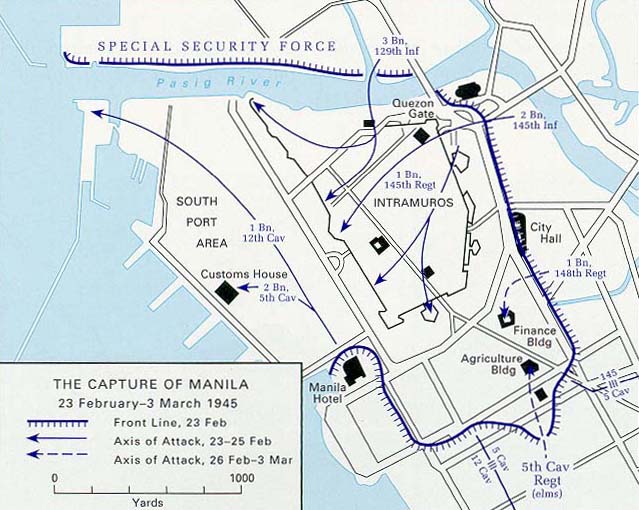
Map of the capture of Manila

On 3 February, elements of the U.S. 1st Cavalry Division under Maj. Gen. Verne D. Mudge pushed into the northern outskirts of Manila and seized a vital bridge across the Tullahan River, which separated them from the city proper. A squadron of Brig. Gen. William C. Chase's 8th Cavalry, the first unit to arrive in the city, began a drive towards the sprawling campus of the University of Santo Tomaswhich had been turned into an internment camp for civilians and the US Army and Navy nurses sometimes known as the "Angels of Bataan".

Letran College behind the Old Spanish Wall that was pulverized by American shelling during the Battle for Manila, Intramuros, Manila, Philippines, 1945

This is where the Americans shelled the wall to open a quicker way in to the walled city where the Japanese were making their last stand in the city.

Since 4 January 1942, a total of thirty-seven months, the university’s main building had been used to hold civilians. Out of 4,255 prisoners, 466 died in captivity, three were killed while attempting to escape on 15 February 1942, and one made a successful breakout in early January 1945.

At 21:00, a lead jeep crashed into the main gate, triggering a firefight, and its driver, Capt. Manuel Colayco, a USAFFE guerrilla officer, became the first known Allied casualty of the city's liberation. He and his companion Lt. Diosdado Guytingco guided the American First Cavalry. Both were unarmed. Colayco died seven days later in Legarda Elementary School, which became a field hospital. Simultaneously, a single tank of the 44th Tank Battalion, named "Battlin' Basic," rammed through the university walls, Sgt Austin E. Aulds from Texas, a combat medic was the second US Soldier to enter, while four others entered through the Calle España entrance. American troops and Filipino guerrillas immediately followed and, after a brief skirmish, freed many of the internees.

The Japanese, commanded by Lt. Col. Toshio Hayashi, gathered the remaining internees together in the Education Building as hostages, and exchanged pot shots with the Americans and Filipinos. The next day, 4 February, they negotiated with the Americans to allow them to rejoin Japanese troops to the south of the city. The Filipinos and Americans agreed but only allowed them to carry their rifles, pistols and swords. That same day, a patrol from the 37th Infantry Division and 31st Infantry Division came upon more than 1,000 prisoners of war, mostly former defenders of Bataan andCorregidor held at Bilibid Prison, which had been abandoned by the Japanese.

On the morning of 5 February, forty-seven Japanese were escorted out of the university to the spot they requested. Each group saluted each other and departed. The Japanese were unaware the area they requested was near the American-occupied Malacañan Palace and soon afterwards were fired upon and several were killed including Hayashi. Later in the afternoon, the survivors returned to the university and were captured.

In total, 5,785 prisoners were freed: 3,000 Filipinos, 2,870 Americans, 745 British, 100 Australians, 61 Canadians, 50 Dutch, 25 Poles, 7 French, 2 Egyptians, 2 Spanish, one Swiss, one German, and one Slovak.[citation needed]

[edit]Encirclement and massacres

Earlier on 4 February, General MacArthur had announced the imminent recapture of the capital while his staff planned a victory parade. But the battle for Manila had barely begun. Almost at once the 1st Cavalry Division in the north and the 11th Airborne Division in the south reported stiffening Japanese resistance to further advances into the city.

Following the initial American breakthrough on 4 February, fighting raged throughout the city for almost a month. The battle quickly came down to a series of bitter street-to-street and house-to-house struggles. In the north, General Griswold continued to push elements of the XIV Corps south from Santo Tomas University toward the Pasig River . Late on the afternoon of 4 February, he ordered the 2nd Squadron, 5th Cavalry, to seize Quezon Bridge, the only crossing over the Pasig that the Japanese had not destroyed. As the squadron approached the bridge, Japanese heavy machine guns opened fire from a formidable roadblock thrown up across Quezon Boulevard, forcing the cavalry to stop its advance and withdraw until nightfall. As the Americans and Filipinos pulled back, the Japanese blew up the bridge.

On 5 February, the 37th Infantry Division began to move into Manila, and Griswold divided the northern section of the city into two sectors, with the 37th responsible for the western half and the 1st Cavalry Division responsible for the eastern sector. By the afternoon of 8 February, 37th Division units had cleared most of the Japanese from their sector, although the damage done to the residential districts was extensive. The Japanese added to the destruction by demolishing buildings and military installations as they withdrew.

The bitterest fighting for Manila—which proved costliest to the 37th—occurred on Provisor Island, a small industrial center on the Pasig River. The Japanese garrison, probably less than a battalion, managed to hold off Beightler's infantrymen until 11 February.

Mudge's 1st Cavalry Division had an easier time, encountering little opposition in the suburbs east of Manila. Although the division's 7th and 8th Cavalry Regiments fought pitched battles near two water supply installations north of the city, by 10 February, the cavalrymen had extended their control south of the river. That night, the XIV Corps established for the first time separate bridgeheads on both banks of the Pasig River.

The final attack on the outer Japanese defenses came from the 11th Airborne Division, under XIV Corps control since 10 February. The division had been halted at Nichols Field on 4 February and since then had been battling firmly entrenched Japanese naval troops, backed up by heavy fire from concealed artillery. The airfield finally fell to the paratroopers the next day, and the acquisition allowed Maj. Gen. Swing's division to complete the U.S. encirclement of Manila on the night of 12 February.

In an attempt to protect the city and its civilians, MacArthur had placed stringent restrictions on U.S. artillery and air support. But massive devastation to the urban area was not avoided. Iwabuchi's sailors, marines and Army reinforcements, having initially successfully resisted American infantrymen armed with flamethrowers, grenades and bazookas, faced direct fire from tanks, tank destroyers, and howitzers, who attacked one building after another and killed the Japanese—and often the trapped civilians—inside, without differentiation.[5]

Subjected to incessant pounding and facing certain death or capture, the beleaguered Japanese troops took out their anger and frustration on the civilians caught in the crossfire, committing multiple acts of severe brutality, which later would be known as the Manila Massacre. Violent mutilations, rapes, and massacres on the populace accompanied the battle for control of the city, which lay practically in ruins. General Yamashita was subsequently blamed for the massacres and hanged for war crimes in 1946 even though he had no responsibility for the battle itself.

Intramuros devastated

File:Sherman intramuros.jpg

M4 Sherman tank at the ruins of the Fort Santiago gate, Intramuros, February 28, 1945

The fighting for Intramuros, where Iwabuchi held around 4,000 civilian hostages, continued from 23 February to 28 February. Already having decimated the Japanese forces by bombing, American forces used artillery to try to root out the Japanese defenders. However, the centuries-old stone ramparts, underground edifices, the Sta. Lucia Barracks, Fort Santiago, and villages within the city walls all provided excellent cover. Less than 3,000 civilians escaped the assault, mostly women and children who were released on 23 February afternoon.[6] Colonel Noguchi's soldiers and sailors killed 1,000 men and women, while the other hostages died during the American shelling.[7]

American soldiers of “C” company of the 148th Infantry cautiously move toward the Legislature Building, Manila, Philippines, Feb. 1945

After shelling the Legislature Building and Intramuros with a three day barrage of artillery fire “C” company of the 148th Infantry move toward the Legislature Building in the early morning. Tanks on the right have ceased firing on the build and have moved back. This is probably Taft Ave. but I am not sure.

The last pocket of Japanese resistance at the Finance Building, which was already reduced to rubble, was flushed out by heavy artillery on 3 March. Iwabachi was said to have committed seppuku (ritual suicide) on February 25, but his body was never found.

Army Historian Robert R. Smith wrote: "Griswold and Beightler were not willing to attempt the assault with infantry alone. Not expressly enjoined from employing artillery, they now planned a massive artillery preparation that would last from 17 to 23 February and would include indirect fire at ranges up to 8,000 yards as well as direct, point-blank fire from ranges as short as 250 yards. They would employ all available corps and division artillery, from 240mm howitzers down. (...) Just how civilian lives could be saved by this type of preparation, as opposed to aerial bombardment, is unknown. The net result would be the same : Intramuros would be practically razed." "That the artillery had almost razed the ancient Walled City could not be helped. To the XIV Corps and the 37th Division at this state of the battle for Manila, American lives were understandably far more valuable than historic landmarks. The destruction stemmed from the American decision to save lives in a battle against Japanese troops who had decided to sacrifice their lives as dearly as possible".

Before the fighting ended, MacArthur summoned a provisional assembly of prominent Filipinos toMalacañan Palace and in their presence declared the Commonwealth of the Philippines to be permanently reestablished. "My country kept the faith," he told the gathered assembly. "Your capital city, cruelly punished though it be, has regained its rightful place—citadel of democracy in the East."

Aftermath

For the rest of the month the Americans and Filipino guerrillas mopped up resistance throughout the city. With Intramuros secured on 4 March, Manila was officially liberated, but large areas of the city had been leveled. The battle left 1,010 U.S. soldiers dead and 5,565 wounded. An estimated 100,000 Filipinos civilians were killed, both deliberately by the Japanese and from artillery and aerial bombardment by the U.S. military force. 16,665 Japanese dead were counted within Intramurosalone.[11]

In the month-long battle, the Americans and Japanese inflicted worse destruction on Manila than the German Luftwaffe had exacted upon London,[12] which resulted in the destruction of the city and in a death toll comparable to that of the Tokyo firebombing or the atomic bombing of Hiroshima.

[edit]Destruction of the city

The battle for Manila was the first and fiercest urban fighting in the entire Pacific War, from the time MacArthur started his leapfrogging campaign from New Guinea in 1942, leading to the invasion of Japan in 1945. Few battles in the closing months of World War II exceeded the destruction and the brutality of the massacres and savagery of the fighting in Manila.

A steel flagpole stands at the entrance to the old U.S. Embassy building in Intramuros, which was pockmarked by numerous bullet and shrapnel hits, and still stands today, a testament to the intense, bitter fighting for the walled city. In this category, Manila joined Stalingrad as being the host to some of the fiercest urban fighting during the war.

Filipinos lost an irreplaceable cultural and historical treasure in the resulting carnage and devastation of Manila, remembered today as a national tragedy. Countless government buildings, universities and colleges, convents, monasteries and churches, and their accompanying treasures dating to the founding of the city, were ruined. The cultural patrimony (including art, literature, and especially architecture) of the Orient's first truly international melting pot - the confluence of Spanish, American and Asian cultures - was eviscerated. Manila, once touted as the "Pearl of the Orient" and famed as a living monument to the meeting of Asian and European cultures, was virtually wiped out.

Most of the buildings damaged during the war were demolished in the name of "Progress" after the Liberation, as part of rebuilding Manila, replacing European style architecture during the Spanish and early American era with modern American style architecture. Only a few old buildings remain intact.


American soldiers of “F” company, 145th Infantry in front of the Post office, Manila, Philippines, Feb. 1945

The final assault of Manila’s last Japanese stronghold of Intramuros was delivered from the steps of Manila’s Post Office building on the banks of the Pasig River. They proceeded through an opening that was blasted through the old 20-foot thick walls of Intramuros by repeated heavy gun shelling. American heavy guns and tanks inflicted the damage to the Post Office Building from the southern wall of Intramuros.

Filipino citizens that were lined up against a wall and killed by the Japanese, Ermita, Manila, Philippines, Feb. 1945

Filipino civilians were hiding in the basement of a nearby building in Ermita. The Japanese found them and told them they should come with them for protection from the advancing Americans. Instead they were taken to this stone wall and shot by the Japanese. One lived to tell of what happened. Here a Filipino resident of the district tries to identify the bodies. After the Battle for Manila a dead Japanese officer was found to have written orders to eliminate all non-Japanese.

Innocent Filipino civilian citizens running from the horrors of war, Manila, Philippines, Feb. 1945

During the battle for Manila innocent civilian citizens running from the horrors of war and hidden Japanese snipers that were shooting at anyone that wasn't Japanese that came into their gun sights.
Those of us that have never gone through these horrors have no idea of what it could have been like. Seeing their friends and family members, their children and parents brutality murdered in horrific ways and numbers. I feel so sad and I have wonderment how so many were able to go on with any semblance of a happy life.

The Battle for Manila from February 3 to March 3 1945, fought by U.S. and Japanese forces, was part of the Philippines' 1945 campaign. The one-month battle which culminated in a terrible bloodbath and total devastation of the city was the scene of the worst urban fighting in the Pacific theater, ended almost three years, 1942-1945 of Japanese military occupation in the Philippines. The city's capture was marked as General Douglas MacArthur's key to victory in the campaign of reconquest.


The battle for Manila was the first and fiercest urban fighting in the entire Pacific War, from the time MacArthur started his leapfrogging campaign from New Guinea in 1942, leading to the invasion of Japan in 1945. Few battles in the closing months of World War II exceeded the destruction and the brutality of the massacres and savagery of the fighting in Manila.

A steel flagpole at the entrance to the old U.S. Embassy building in Intramuros, which was pockmarked by numerous bullet and shrapnel hits, and still stands today, a testament to the intense, bitter fighting for the walled city. In this category, Manila joined the company of Warsaw as the most devastated cities of World War II, as well as being the host to some of the fiercest urban fighting since Stalingrad....
Filipinos lost an irreplaceable cultural and historical treasure in the resulting carnage and devastation of Manila, remembered today as a national tragedy. Countless government buildings, universities and colleges, convents, monasteries and churches, and their accompanying treasures dating to the founding of the city, were decimated.

The cultural patrimony (including art, literature, and especially architecture) of the Orient's first truly international melting pot - the confluence of Spanish, American and Asian culture - was eviscerated. Manila, once touted as the "Pearl of the Orient" and famed as a living monument to the meeting of American,Asian and European cultures, was virtually wiped out.......
The Worst Kind of Tragedy in The Philippines' History!!!!....

Liberated prisoners of Los Banos interment camp at Laguna de Bay, Feb. 1945 Here the liberated prisoners of Los Banos interment camp disembark from an American Amtrack after being taken to safety by way of the Amtrack across Laguna de Bay, Feb. 1945

Filipino Blue Eagle Guerrillas give directions to American servicemen, March 1945 .The groups of guerrillas in the Philippines have been contributing invaluable aid to our fighting forces, such a roaming the streets looking for snipers and for Japs who have switched into civilian clothes. One of their prime functions is to give directions and warn our men of mine fields that the Japs has sown over almost every major thoroughfare in Manila. Here, a group of the famed Blue Eagle Guerrillas is stopped by one of our tanks for spot of directions. Note the variance of armament and the contrast of their midget Jap-automobile to the huge Sherman tank.

1945:  American troops carrying their dead and wounded during a battle to liberate the Philippines from the Japanese during World War II

+13

1945: American troops carrying their dead and wounded during a battle to liberate the Philippines from the Japanese during World War II

Destruction: The U.S. liberated the Philippine capital from the Japanese, but not before Manila was destroyed and more than 100,000 civilians killed

+13

Destruction: The U.S. liberated the Philippine capital from the Japanese, but not before Manila was destroyed and more than 100,000 civilians killed

He called the city 'one of the worst battlefields in the world.'

When the Japanese invaded the Philippines, then an American colony, in 1941, Gen. Douglas MacArthur, commander of the U.S. forces there, declared Manila an 'open city' to spare it from destruction.

But when the Americans returned, the Japanese decided to fight to the last man, from building to building, and burned entire city blocks.

Civilians died from malnutrition and American shelling, but mostly, historians agree, at the hands of Japanese troops.

Four survivors shared their stories with The Associated Press.

Roderick Hall was 9 when the Japanese occupied Manila. The British boy and his family lived in a home in the Malate district, though his father was interned with thousands of foreigners at the University of Santo Tomas.

In late January 1945, before American forces closed in on the capital, the Japanese barged into the family home, searched every room and found what the raiders claimed was an illegal radio transmitter. Hall, now a business investor, said it was just a short-wave radio the family listened to for news outside Manila.

War: American artillery crews firing on Japanese positions from the grounds of the recently liberated Santo Tomas University during the Battle for Manila. ended the three-year Japanese military occupation in the Philippines

+13

War: American artillery crews firing on Japanese positions from the grounds of the recently liberated Santo Tomas University during the Battle for Manila. ended the three-year Japanese military occupation in the Philippines

Fire: American artillery crews of 1st Cavalry Division firing on Japanese positions from the grounds of the recently liberated Santo Tomas University during the Battle for Manila

+13

Fire: American artillery crews of 1st Cavalry Division firing on Japanese positions from the grounds of the recently liberated Santo Tomas University during the Battle for Manila

Winners: Soldiers takiw a breather after their victory of taking a building during the battle for Manila, liberation of the Philippines, during WWII

+13

Winners: Soldiers takiw a breather after their victory of taking a building during the battle for Manila, liberation of the Philippines, during WWII

On guard:  American troops during the battle of Manila. The fighting took place from February 3 to March 3, 1945

+13

On guard: American troops during the battle of Manila. The fighting took place from February 3 to March 3, 1945

All members of the household - including Hall and his brother, his mother, his grandmother, an uncle, and aunt and the family's helpers - were brought to Manila's Masonic Temple.

Hall, then 12, and his brother and the house helpers were later released. They were allowed to bring food to their mother and the others for several days. Then the Japanese stopped the visits.

About 200 people were massacred at the temple, but Hall learned only recently from a war document that his mother was listed among dozens executed at Fort Santiago, a centuries-old Spanish garrison used by occupation troops to torture and kill suspected guerrillas.

For a while, Hall had hoped that his mother somehow escaped and was safe with the guerrillas.

'About two years later, I was away in school. My father wrote and said, `I am going to marry again.' And that's when I started to cry and broke down and had to admit to myself that this hope that my mother was alive somewhere was no longer the case.'

For someone who was 4 when the Japanese began bombing raids on Manila in December 1941, Juan 'Johnny' Rocha remembers a lot from the war. Perhaps because, when those first bombs were falling, he was being rushed for an appendectomy - not in the operating room, but to the hospital basement, where it was safer.

Looking back: Roderick Hall gestures during an interview as he attends a commemorative event for the 70th year of the Battle for Manila at the Ayala Museum in suburban Makati, south of Manila, Philippines. Hall was 9 when the Japanese occupied Manila

+13

Looking back: Roderick Hall gestures during an interview as he attends a commemorative event for the 70th year of the Battle for Manila at the Ayala Museum in suburban Makati, south of Manila, Philippines. Hall was 9 when the Japanese occupied Manila

Remembering: In late January 1945, before American forces closed in on the capital, the Japanese barged into the family home of Rorderick Hall, searched every room and found what the raiders claimed was an illegal radio transmitter. Hall, now a business investor, said it was just a short-wave radio the family listened to for news outside Manila

+13

Remembering: In late January 1945, before American forces closed in on the capital, the Japanese barged into the family home of Rorderick Hall, searched every room and found what the raiders claimed was an illegal radio transmitter. Hall, now a business investor, said it was just a short-wave radio the family listened to for news outside Manila

Rocha, who later would become the Philippine ambassador to Spain, once saw a man hanging dead from a telephone pole, with a sign that said he was a thief. He remembers his family using huge wads of devalued Japanese wartime currency to buy basic commodities, and privately singing 'God Bless America,' and 'I Love My Own, My Native Land' at home.

'The most remarkable thing was whenever we passed in front of a Japanese sentry we had to all bow, and if we didn't bow, he would slap us or kick us or whatever,' he said.

As fighting in Manila intensified, his family decided to flee, but tragedy struck before they could. When a shell landed on a neighbor's house, shrapnel cut through an adobe wall and sliced off the top of his mother's head, killing her.

Rocha's father lost 13 relatives when the Japanese herded them inside the German Club with hundreds of others, then torched them all alive, Rocha said.

Rocha saw Japanese soldiers shoot a man because he didn't raise his hands, and a woman screaming as she was bayoneted against a tree.

'Christians are taught to forgive, but we are never taught to forget. We cannot forget,' he said. 'All we need is that they recognize what they did and apologize.'

Tribute: Joan Bennett Chapman, left, a Philippine-born American, sits beside her daughter Melanie as they attend a movie premier in Manila, Philippines. Chapman remembers being so deprived at the Santo Tomas prison camp that powdered milk was a special treat. When her mother was able to give her a spoonful, she would nibble on it on the steps of the large staircase in the main building

+13

Tribute: Joan Bennett Chapman, left, a Philippine-born American, sits beside her daughter Melanie as they attend a movie premier in Manila, Philippines. Chapman remembers being so deprived at the Santo Tomas prison camp that powdered milk was a special treat. When her mother was able to give her a spoonful, she would nibble on it on the steps of the large staircase in the main building

Museum: visitor looks at photos at a commemorative event for the 70th year of the Battle for Manila at the Ayala Museum in suburban Makati, south of Manila, Philippines. Seventy years have not dulled the memories of survivors of the month-long Battle of Manila

+13

Museum: visitor looks at photos at a commemorative event for the 70th year of the Battle for Manila at the Ayala Museum in suburban Makati, south of Manila, Philippines. Seventy years have not dulled the memories of survivors of the month-long Battle of Manila

Looking back: A visitor looks at an exhibit at a commemorative event for the 70th year of the Battle for Manila at the Ayala Museum. The mass killings by Japanese forces, the loved ones lost and the desperation are etched in their minds

+13

Looking back: A visitor looks at an exhibit at a commemorative event for the 70th year of the Battle for Manila at the Ayala Museum. The mass killings by Japanese forces, the loved ones lost and the desperation are etched in their minds

Joan Bennett Chapman, a Philippine-born American, remembers being so deprived at the Santo Tomas prison camp that powdered milk was a special treat. When her mother was able to give her a spoonful, she would nibble on it on the steps of the large staircase in the main building.

Chapman's father, Roy Bennett, was the first editor-in-chief of the pre-war Manila Daily Bulletin. He was tortured by the Japanese before he and his family were interned.

Chapman, an 80-year-old former lawyer, said internees looked like 'walking skeletons' and starvation deaths were routine. When American tanks crashed through the university gates on Feb. 3, 1945, she heard 'people being hysterically happy.'

'The soldiers were out throwing candy bars down to the people, and the people who were starving were scrambling for them. It was the happiest kind of chaos you can imagine,' she said.

The Japanese camp commandant refused to surrender and was shot as he tried to reach for what was believed to be a grenade in his backpack, she said. His body was dragged to the main building, where some internees spat and urinated on it, she said.

Chapman wanted to spit on the body, too. Her father, who was abused by the occupiers for years and would be tormented by the war for the rest of his life, forbade it.

James Litton, then 11, heard thunderous explosions the day after the Americans reached Manila. The Japanese were blowing up bridges to keep U.S. troops from advancing.

Survivor:James Litton gestures during an interview in Manila, Philippines. Litton, then 11, heard thunderous explosions the day after the Americans reached Manila. The Japanese were blowing up bridges to keep U.S. troops from advancing. Days later, the Japanese began burning houses in the Malate district, where his family lived. Littonís house was made of concrete, so it became an emergency shelter for about 120 homeless neighbors

+13

Survivor:James Litton gestures during an interview in Manila, Philippines. Litton, then 11, heard thunderous explosions the day after the Americans reached Manila. The Japanese were blowing up bridges to keep U.S. troops from advancing. Days later, the Japanese began burning houses in the Malate district, where his family lived. Littonís house was made of concrete, so it became an emergency shelter for about 120 homeless neighbors

Days later, the Japanese began burning houses in the Malate district, where his family lived. Litton's four-story home was made of concrete, so it became an emergency shelter for about 120 homeless neighbors.

Then the Japanese ordered everyone to leave. As civilians hurried toward the nearby Philippine General Hospital for shelter, a 15-year-old girl stepped on a Japanese land mine.

'After the dust had settled, all I could see was a torso, legless, without the left arm. She was moaning still but her blood was coagulating with dust,' he said. His mother lay unconscious nearby and his brother was wounded in the face.

A cousin carried his mother and they ran toward the hospital. Japanese snipers were targeting people entering the main gate, so they climbed over a fence.

Finally, on Feb. 17, Americans reached the area. 'I was just filled with happiness. My chest was bursting with joy realizing that we had survived. We're alive! We're alive!' said Litton, now 81.

As they moved out of the hospital, he saw the body of a Japanese soldier lying on the street. 'What I can't forget is when we were walking, an elderly man got an adobe stone and with all his might threw it at this dead Japanese,' and cursed, he said.

Later, as a textile businessman, Litton often visited Japan.

'I never met a more hospitable, a more cultured, a more accommodating people,' he said. 'How could a people like this have produced an army as barbaric as the one that came here and Nanking? ... Nobody has yet explained that to me.'


South bank of the Pasig River from MacArthur Bridge

14-NOV-2008

South bank of the Pasig River from MacArthur Bridge

Nikon D200


Jeepney on MacArthur Bridge, Manila

14-NOV-2008

Jeepney on MacArthur Bridge, Manila


Manila Central Post Office

14-NOV-2008

Manila Central Post Office


Luneta Pond, Rizal Park

14-NOV-2008

Luneta Pond, Rizal Park


Busts of historic figures from Filipino history

14-NOV-2008

Busts of historic figures from Filipino history


Department of Tourism of the Philippines, Manila

14-NOV-2008

Department of Tourism of the Philippines, Manila


Malate, looking east from Pearl Garden Hotel

27-APR-2009

Malate, looking east from Pearl Garden Hotel


Royal Plaza twin towers, Malate

27-APR-2009

Royal Plaza twin towers, Malate


Malate, looking west from Pearl Garden Hotel, M. Adriatico St.

15-APR-2009

Malate, looking west from Pearl Garden Hotel, M. Adriatico St.

Malate, looking west from Pearl Garden Hotel, at night

14-APR-2009

Malate, looking west from Pearl Garden Hotel, at night


SM Mall of Asia, Manila

24-APR-2009

SM Mall of Asia, Manila


SM Mall of Asia, Manila

24-APR-2009

SM Mall of Asia, Manila

SM Mall of Asia, Manila

24-APR-2009

SM Mall of Asia, Manila


Manila Bay waterfront along Seaside Blvd in front of SM Mall of Asia

24-APR-2009

Manila Bay waterfront along Seaside Blvd in front of SM Mall of Asia


University of Santo Tomas, Manila

25-FEB-2010

University of Santo Tomas, Manila


UST Hospital, Manila

25-FEB-2010

UST Hospital, Manila


University of Santo Tomas, Manila

25-FEB-2010

University of Santo Tomas, Manila


An aerial shot of flooding around Marikina town, suburban Manila

An aerial shot of flooding around Marikina town, suburban ManilaPicture: Department of National Defence (DND) / AFP/GettyImages

Residents wade along a flooded road in Marikina City, east of Manila

Residents wade along a flooded road in Marikina City, east of Manila


A resident wades along a flooded street in suburban Manila

A resident wades along a flooded street in suburban Manila


Plaza Santa Cruz

03-FEB-2004

Plaza Santa Cruz


Plaza Santa Cruz

03-FEB-2004

Plaza Santa Cruz


Chinatown, Manila

03-FEB-2004

Chinatown, Manila


Pasig River, Manila

03-FEB-2004

Pasig River, Manila


Recto LRT Station, Manila

14-NOV-2008

Recto LRT Station, Manila


View from Recto LRT station, Manila

14-NOV-2008

View from Recto LRT station, Manila


Tin shanties behind a high wall, Recto Avenue, Manila

14-NOV-2008

Tin shanties behind a high wall, Recto Avenue, Manila


Railroad and LRT bridges at the intersection of Recto and Rizal Avenues, Manila

14-NOV-2008

Railroad and LRT bridges at the intersection of Recto and Rizal Avenues, Manila


Plaza Lacson on the north side of the Pasig River

14-NOV-2008

Plaza Lacson on the north side of the Pasig River


Prudentian Bank, Plaza Lacson, Manila

14-NOV-2008

Prudentian Bank, Plaza Lacson, Manila

Road leading from the north end of the MacArthur Bridge, Manila

14-NOV-2008

Road leading from the north end of the MacArthur Bridge, Manila


Pasig River from Mer Ka Toor Bridge

14-NOV-2008

Pasig River from "Mer Ka Toor" Bridge


Post Office and Pasig River from MacArthur Bridge

14-NOV-2008

Post Office and Pasig River from MacArthur Bridge


FEATI (Far Eastern Aeronautics Technical Institute) University

14-NOV-2008

FEATI (Far Eastern Aeronautics Technical Institute) University


Escolta Twintowers on the north bank of Pasig River from MacArthur Bridge

14-NOV-2008

Escolta Twintowers on the north bank of Pasig River from MacArthur Bridge


This was the old military reservation now called Bonifacio Global City.  I always pass by this golf course on Mckinley Road during my teen years. What I remember most was the abundance of huge acacia trees and vegetation that made the place cool. Established in 1901, this is undoubtedly Manila's preeminent golf club. The 18-hole course is impeccably maintained, while the clubhouse features a coffee shop, a restaurant and a gym for the relaxation of members.


When you look back at this rich opulent view of Manila, we see the difference of how the haves and the have not. It has widened still after WWII. This issue has never been  more clear in my understanding. We learn more of our true history in our social intercourse on rural justice more than the news/books from the Western Media in our classroom years. We were somewhat brainwashed to think that people who fight to uplift themselves from social oppression were all bad. To look at the true story of the HUK Insurrection in the Philippines, is to open both sides of society, the poor and the rich.
As originally constituted in March of 1942, the Hukbalahap was to be part of a broad frontresistance to the Japanese occupation of the Philippines. This original intent is reflected in its name:"Hukbong Bayan Laban sa mga Hapon", which was "People's Army Against the Japanese" when translated into English. The adopted slogan was "Anti-Japanese Above All". The Huk Military Committee was at the apex of Huk structure and was charged to direct the campaign and to lead the insurrection that would seize power after the war. Luis Taruc a communist leader and peasant-organizer from a barrio in Pampanga; was elected as head the committee, and became the first Huk commander called "El Supremo"......more

THE PEASANT (HUK) INSURRECTION

Review at Fort William McKinley Manila Philippines

    AT FORT WILLIAM McKINLEY

Fort William McKinley where we transferred from Dewey Blvd. MNS lived here in the later half of the 1960’s, was established in the Philippines during the Philippine–American War in 1901. The land is situated south of Pasig River down to the creek of Alabang, Manila, Philippines and was declared as U.S. military reservation by the Secretary of War, Elihu Root, expropriating the land owned by Capitan Juan Gonzales without compensation. .

The bulk of the Philippine Division was stationed there and this was where, under the National Defense Act of 1935, specialized artillery training was conducted.

On May 14, 1949, Fort McKinley was turned over to the Philippine government. The facility became the home of the Philippine Army and later the Philippine Navy and renamed Fort Bonifacio where my parents lived until the 1970’s. It lies in the cities of Pasay, Pasig,Parañaque, Makati and Taguig. The Manila American Cemetery and Memorial was established here. Later, it was turned into a real estate development area called Bonifacio Global City.